A PCB stamp to add 140W Power Delivery 3.1 (PD3.1) to any I2C capable microcontroller!
To make the experience fit your profile, pick a username and tell us what interests you.
We found and based on your interests.
Hi all,
I was at Hackaday Supercon 2025 and did a quick 7 minute lightning talk about this project! You can watch it here, timestamp is exactly 1 hour into the video!
I'm continuing to finish the routing and have a couple of logs that will be forthcoming:
I'm planning for logs past these such as prototype feedback and software library implementation but those are further out. Once I order prototypes I plan to release the initial Gerber, Step, and BOM files for JLCPCB.
Note that I will be busier as the year comes to a close so this project will slow down until January 2026. I hope to order the prototypes before 2026 but that is up in the air.
Hi all,
This log will describe what pins we need to define for the PCB package. Below is a list of all inputs and outputs:
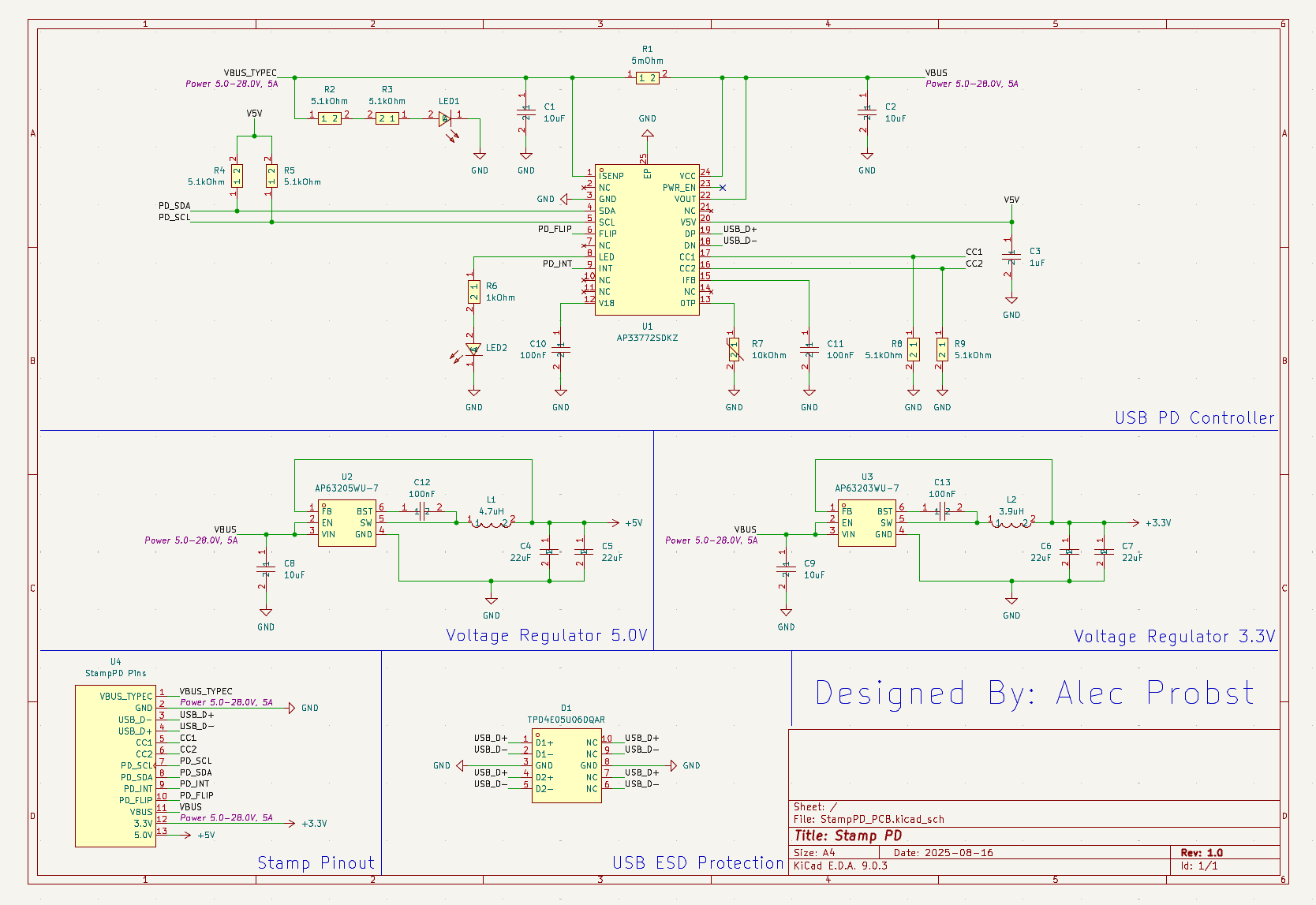
The logic used to determine which side of the PCB pins should be on is to go from left-to-right when looking at the PCB from top down. The logic/power input is on the left side while the logic and 5.0V/3.3V power output is on the right side. The variable USB-C Power output is on the top and bottom. You can see this in the schematic diagram below:
As this stamp will use USB-C for power and data input, the most logical pin input routing should match the expected pinout for a USB-C Female Receptacle. Based on the image below, you can see that this leads to ground on the outside, then power (VBUS), CC Pins, and finally USB D+/- .
The right side output pins on the stamp do not have a likely output order like the left side Input Pins do. As such, they are organized based on ease of routing and part placement. The 5.0V and 3.3V power output pins flank the top and bottom due to the placement of the buck converters for the associated voltages. Next are the communication pins for SDA and SCL and the PD Controller INT and FLIP logic pins. The SDA/SCL pins were placed on the top due to their necessary components needed for the SDA/SCL pins being located on the top while the INT and FLIP pins were closest to the bottom side of the PD Controller. Finally, the CC and USB D pins simply route from left to right across the PCB.
The top and bottom pin placement alternates between power output and ground pins, separated by a No Connect (NC) pin in-between. The NC pin was included to make it more unlikely that the power output pins and ground pins could be accidentally shorted when soldering StampPD. Its unclear if this is an optimal power pinout setup and would love feedback on this design choice.
Hi all,
In this log I'll go over the specific component selection for the USB PD Controller.
A USB PD Controller Sink is an IC that communicates with the USB PD standard to set a voltage and current from a USB PD source for downstream devices. The selected USB PD Controller for StampPD is the AP33772S. This IC comes in two variants , the AP33771C and the AP33772S. The C variant is a version which uses resistors to select the desired current and voltage while the S variant uses I2C to communicate with a microcontroller to select the voltage and current. In StampPD, we will use the S variant for its ability to change and request different voltages and currents. The controller selection was inspired by controller in the PicoPD which used an older version called the AP33772. This controller is Not Recommended for New Design (NRND) by the manufacturer, Diodes, and is only compatible with the USD PD3.0 standard. The AP33772S is compatible with the newer USB PD3.1 standard. I compared a couple differences between these two controllers in the Design Objectives log if you wish to see why this version was chosen. I attempted to research USB PD3.2 controllers that were similar to the AP33772S but was not able to find any, likely due to the standard being more recently released. Some reasons I've selected the AP33772S were:
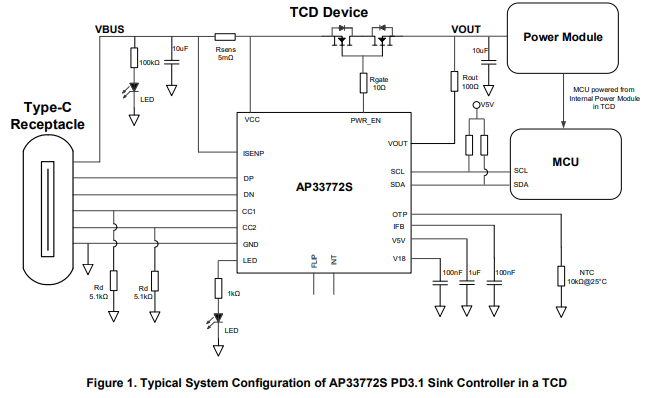
Below, an example circuit, called Figure 1, shows what an implementation of the AP33772S should look like with some specified component values. A table called Pin Descriptions describe the functions and voltage / current for pins of the AP333772S. Since the circuit diagram + table gives us a good idea of what to implement for this IC, I'll describe the more important/complicated components and only put component values in a list for the others.
This resistor sits between ISENP (Current Sense Pin) and VCC. It is used by the AP33772S to determine the amount of IR drop through VBUS for overcurrent protection. Since VBUS supports 5A and the recommended resistance is 5mOhm, this resistor needs to support at least 5A^2 * 5mOhm = 0.125W ( P = I^2 * R ). We'll want to give around a 50% power margin here so our target resistor power rating is 0.125W * 1.5 = 0.1875W. We should also limit the resistance tolerance to within 1% to reduce variability and power loss.
This pin is described as outputting up to 5.33V, 2mA. If we use the suggested 1000Ohm resistance value, we should look for a LED with a Forward Voltage (Vf ) = Voltage Source - Resistor * Forward Current. Vf = 5.33V - 1000Ohms * 2mA = 3.33V. This means if we keep the suggested 1000Ohm resistor and assume 2mA of Forward Current, we should look for a LED with a Forward Voltage of 3.33V. This will likely be a blue or white colored LED.
This resistor is used to detect the temperature around the IC. When NTC resistors heat up, their resistance decreases. This can be detected to determine overheating conditions. For this IC, it's calibrated for a NTC resistor that has a resistance of 10KOhm when the temperature is 25C.
For the VBUS LED and Resistors, I'm ignoring the values suggested in the circuit diagram. Instead,...
Read more »Hello all,
In this log I'll go over the specific component selection for the 5.0V and 3.3V Buck Converters. Since I am using the same IC for both 5.0V and 3.3V, most of the components will be duplicated between the IC's. Only the inductors will be different between the two implementations.
The main buck converter IC is the AP6300. This IC comes in a couple different flavors including a 3.3V ( AP63203 ) and a 5.0V ( AP63205 ) version which I've selected for StampPD. Some reasons I've selected this IC were:
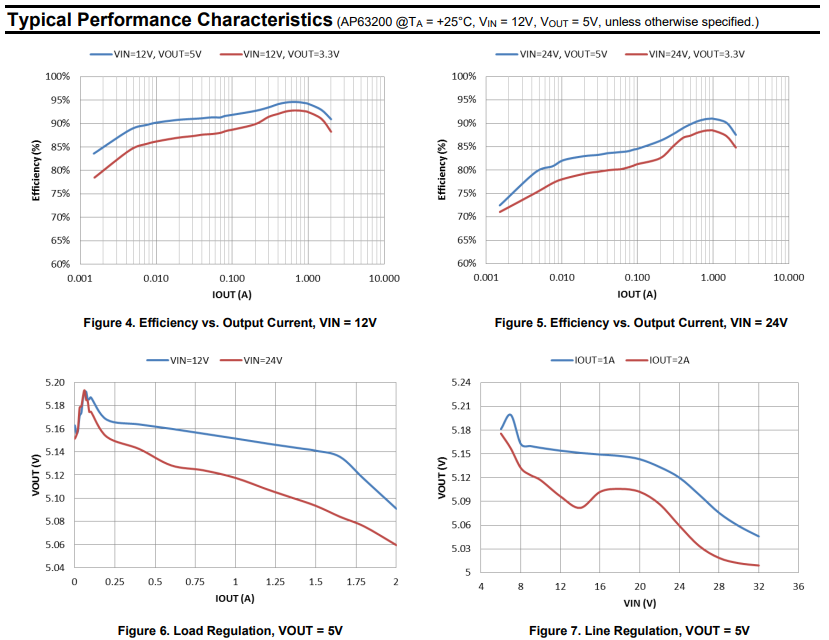
Below are the efficiency, load, and line regulation curves for the AP6300. Figure 4 shows the efficiency at different output current for 12V, Figure 5 shows the efficiency at different output currents at 24V. The blue line is 5.0V output, the red line is 3.3V output. Figure 6 shows the expected output voltage at different currents. The blue line is input voltage of 12V, the red line is input voltage of 24V. Figure 7 shows the expected output voltage with different input voltages. The blue line is output current of 1A, the red line is output current of 2A. From these we can take away a couple things:
I expect that for the 5.0V AP63205 I should see around 5.20V at low input voltage and low output current. As the input voltage and output current increase, I expect the output voltage to drop to just above 5.0V.
Using the efficiency trends in Figure 4 and Figure 5, I will guess that voltage for the 3.3V AP63203 will likely be worse (higher voltage at lower output currents and input voltages). Using the efficiency percentage difference of around 5% in Figures 4 and 5, and the voltage difference of around 0.2V from Figures 6 and 7, assuming this IC outputs 3.3V at around 2A 32V input, I calculate an output voltage around 3.3V + 0.2V * 1.05% = 3.51V.
I expect that for the 3.3V AP63203 I should see around 3.51V at low input voltage and low output current. As the input voltage and output current increase, I expect the output voltage to drop to just above 3.3V.
Below, an example circuit, called Figure 1, shows what an implementation of the AP63205 should look like. Two tables, called Table 2 and Table 3, show recommended component values....
Read more »Hi all!
In this log I'm going to go over my methodology for component selection. I will explain what subsystems I want to include on StampPD, component requirements, other influencing factors, and a summary of component restrictions. In the next couple logs I will go over each sub-system of the board component by component to explain my part choices. I hope to show how I went about component selection to give new PCB designers an idea of how I approached this this design as well as receive feedback from more experienced designers. I have minimal experience with power design so I'm sure I've made mistakes somewhere here!
There are 5 main parts of StampPD:
These 5 parts are combined together to create the stamp. Only two of these sub-systems are absolutely necessary, the PCB and the USB PD Controller. The USB ESD Protection is nice to have but is optional. Being only a single component (TPD4E5U06DQAR) it would be easy to remove. The 5.0V and 3.3V Regulators are also nice to have but could be removed if needed.
There are a couple requirements I've put on the design that influence what parts I want to select:
I have some personal external factors that also limit my part selection:
Here is a summary of the restrictions that I have put on component selection:
Hello everyone!
This is a quick update about my decision on the 5V and 3.3V regulators.
Last time I mentioned a couple methods for regulating the 5V and 3.3V which were:
I mentioned last time that I was planning to go with one of the Buck Booster options. However, I've changed my mind! Instead I'm going to just use Buck Converters
After thinking about these solutions for a while, I realized that the drop in voltage on the 5V pin when the input voltage is 5V is ok with my design choice for now. The reasons for this are:
For now I think simplicity and cost are more important than sacrificing a little bit of voltage here. I plan to test the 5V rail to see how much voltage drop we get and am leaving the door open on adding a Boost converter later. As a little bit of a sneak peak for next time, here's where the current KiCAD design stands!
Hello all!
In this log I'm going to go over my current progress on the regulator design for the 3.3V and 5V supplies. This design is a bit more complex than I expected for reasons that I'll get into here.
Originally I had been thinking that I would just use two LDO's set to 3.3V and 5V and call it a day. LDO's are very simple to use and setup, however, I ran into some issues when looking at this design choice.
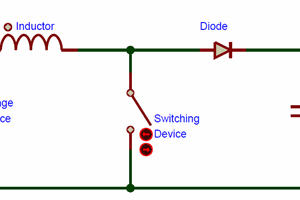
Buck Converters are much more efficient than LDO's when the voltage difference is larger between Voltage Input and Voltage Output. That's good for our efficiency! However, using a Buck Converter has issues as well.
While a Buck Converter can't regulate our Voltage In = Voltage Out issue for 5V, we could step up the voltage to 5V with a Boost Converter. There are two options for this with some trade-offs:
Hi all!
This log is to define the goals for this project. I want to establish what the design objectives of the StampPCB will be.
This project was inspired by the PicoPD. This board adds USB-C Power Delivery to a RP2040. Want variability in the USB-C PD just like this board.
The stamp design is inspired by the RP2350 Stamp. Want a drop in component just like this stamp.
Current part choices are influenced by the PicoPD. Want to upgrade from the AP33772 to the AP33772S for a more up to date PD spec (PD3.0 vs PD3.1). This allows for an increase from 100W (20V, 5A) to 140W (28V, 5A) as well as a couple other features. The downside is that there is less fine grain control of the voltage and amperage (20mV vs 100mV increments and 50mA vs 250mA increments)
While StampPD is designed to be as microprocessor agnostic as I can make it, I do have a board I want to build with it in mind. That board currently uses the RP2350 Stamp with StampPD and a third USB-PD High Power GPIO Stamp to allow the RP2350 to control pins at the max power of StampPD. This project will come after StampPD is finished
Create an account to leave a comment. Already have an account? Log In.
Become a member to follow this project and never miss any updates
About Us Contact Hackaday.io Give Feedback Terms of Use Privacy Policy Hackaday API Do not sell or share my personal information
w_k_fay
Kuba Sunderland-Ober