Close
0%
0%

AEFC - Ambient Energy Field Converter

A system designed to capture and collect energy from EMFs, now being refined to enhance circuit efficiency and output.

Similar projects worth following
This is a experimental energy harvesting system exploring nontraditional coil interactions, ground potentials, and ambient EMF dynamics. Its powered by curiosity and built to challenge the boundaries of passive energy capture.

The Ambient Energy Field Converter (AEFC) is an experimental platform for capturing and converting ambient energy from Earth’s ground potential, local electromagnetic fields, and other passive sources. By combining custom coil configurations, capacitive components, and nonlinear circuit behavior, the AEFC investigates how subtle environmental energies can be harvested, stored, and made useful, especially in ultra-low-power applications.

  Unlike conventional energy harvesters, the AEFC exhibits dynamic, field-reactive behavior. Voltage levels fluctuate in response to environmental changes, human proximity, and even direct touch, suggesting a capacitive coupling mechanism at work. These emergent responses offer a new direction for ambient energy exploration, circuits that don’t just harvest energy, but interact with their surroundings. AEFC remains in active development, with discoveries driven by hands-on experimentation and intuitive systems thinking.

  The component lists is not exhaustive. The project is in active development, with discoveries emerging through direct experimentation and iterative design.

Coil3PulseReturns.mp4

Video of coil 3 AC Pulse that has returned after capacitor bank reached 7.40 vdc.

MPEG-4 Video - 15.72 MB - 10/05/2025 at 08:22

Download

Touch.mp4

Human touch to the DC rectifier circuit causes a noticeable rise in AC voltage as measured by the voltmeter.

MPEG-4 Video - 23.41 MB - 07/20/2025 at 18:42

Download

voltageaefc.mp4

Video of Coil 3 AC Voltage Pulse

MPEG-4 Video - 10.43 MB - 06/04/2025 at 16:48

Download

  • 2 × 8 Guage Bare Copper Grounding Wire Coil - 50 FT
  • 1 × Full Bridge Rectifier Using 4x HSMS-2820-TR1G Diodes
  • 6 × 2.7 vdc 2 Farad Supercapacitor in series (SCSB) Super Capacitor Storage Bank (SCSB)
  • 1 × 2200 uf Capacitor 50 Vdc Harvester capacitor parallel to SCSB, separated by diode.
  • 1 × 10 uf capacitor 50 vdc

View all 6 components

  • Small adjustments

    Rhea Rae11/15/2025 at 15:19 0 comments

    The AEFC Super Cap Bank is currently at 8.02Vdc out of a total 16Vdc 0.25 Farad capacitance. The Harvest Capacitor is at 8.04 Vdc currently 2200uF.  On coil 3 I placed 10pF capacitors across the three of the four rectifier diodes in the coil.  I am thinking of Putting one across the last rectifier diode in that coil circuit. Coil 3 coil setup is far different than coil 1 and 2 and is completely Positive Biased. I'm curious as to how it would or wouldn't react if I took it to the top of a really high mountain?  There is currently a 1.1 - 1.2Vac voltage reading between coil 1 and 2 as well as 1.5 Vac voltage reading between coil 1 and coil 3.

    -RR

  • Pulse Mode Returns at 7.40 V

    Rhea Rae10/04/2025 at 14:51 0 comments

    The AEFC just hit another milestone. I’ve added a video to the Files section titled Coil3PulseReturns.mp4 that shows what I’m seeing. With the supercapacitor bank steady at 7.40 V DC, the staged AC pulse between Coil 3 and the negative side of the harvest capacitor has returned. I drained the caps first to see if the pulse would ever come back, and honestly I wasn’t sure it would. It did. This is no longer a single observation. After a full drain the pulse returned under the same conditions at about 7.4 V. That is the first hard evidence of a repeatable, state-dependent mode in the AEFC rather than a one-off instance. The sequence is stable and clear: about 4.69 VAC, dropping to zero, spiking to 42.2 VAC, collapsing again, then looping.

      What makes this important is that the pulse only appears once the bank has charged past a threshold. When storage is low, it vanishes. I’ve already seen it absent around 7.2 V and present again around 7.4 V. Once the bank climbs high enough, the system shifts into this mode. That suggests the AEFC isn’t just catching ambient noise. It is running with threshold dependence, with Coil 3 acting like a gate that opens and closes conduction windows in step with the bank’s charge state.

      My current interpretation is that the lower stage around 4.7 VAC is a longer-duty, smaller-amplitude portion of the cycle, while the 42 VAC stage is likely a sharp inductive collapse spike that the handheld meter reports as a high RMS value. The pauses at zero show this isn’t a smooth oscillation but a segmented cycle, which matches the idea of Coil 3 steering energy directionally and changing behavior once the bank crosses that voltage threshold.

      The key here is repeatability. After draining the caps, the staged pulse still returns on its own once the bank climbs high enough without any direct power source. That confirms the AEFC has operating modes dependent on stored energy, a major shift from the early days when it looked more like random field interactions. The circuit now shows signs of self-modulation once it has energy in reserve, and that is a big step forward.

      I’m connecting this result to my working design model I call Rhea’s Law (found on my profile page), written as P = I × E. I’m not proposing a new law of physics; I’m describing how this harvester behaves. Here E is the bias or EMF condition set by the supercap bank, I is the Coil 3 flow that only establishes once that bias crosses a gate, and P is the consequence measured as energy added to the bank. Below about 7.2 V the mode is off, and around 7.4 V it flips on and repeats. That repeatability is the proof that this isn’t an anomaly but a real operating mode, and it ties directly to the threshold-flow-consequence framework of Rhea’s Law.

    -Rhea

  • Out with the Old and In with the New

    Rhea Rae09/01/2025 at 11:09 0 comments

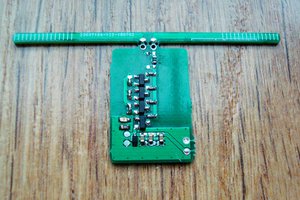
    It’s been a while, but I finally finished up the new full bridge rectifier using the HSMS-2820-TR1G Diodes, the one on the right in the photo. If you knew the detours lately, you’d understand the procrastination. I just wish I had wrapped it sooner.

      After the install, the supercapacitor bank measured 5.51 VDC with the current coil setup feeding into the new bridge. I reset the harvest capacitor that feeds the bank to confirm the charge path, and it’s climbing at just under 2 VDC now. Once the harvest cap catches up to and exceeds the bank voltage plus the bridge drop, it will push current back into the bank again through the voltage difference.

    -RR

  • A Systems Reset

    Rhea Rae07/22/2025 at 15:47 0 comments

    7/22/2025 – I shorted the supercapacitor bank to fully discharge the AEFC system. Following this reset, the previously observed stepped AC pulse pattern ceased entirely. I am now monitoring whether the pulse behavior will re-emerge over time, while tracking the system’s natural recharge dynamics. Prior to discharge, the supercapacitor bank maintained a stable charge of approximately 8 VDC.

    7/29/2025 – With no external input, the supercapacitor bank has passively recharged to 4.58 VDC.

    8/6/2025 – Voltage recovery continues gradually; the supercapacitor bank now measures 4.71 VDC, while the harvest capacitor sits slightly higher at 4.73 VDC. This persistent voltage differential is being monitored for any correlation with system behavior. One possible cause for the cessation of the AC pulse is that the full discharge disrupted an internal charge distribution or resonance condition within the coil-capacitor network. The ongoing voltage rise indicates ambient energy capture is still active, though potentially operating below the threshold required to trigger the stepped pulse pattern observed previously.

    I have not yet completed installation of the new full bridge rectifier, which is being constructed using HSMS-2820-TR1G Schottky diodes. This upgrade is in progress and may influence system response once integrated.

    8/13/2025 – Prior to modification, the supercapacitor bank measured 4.78 VDC. A large pancake coil has now been added beneath Coil 3. The outer ring of the pancake coil is electrically connected to Coil 3, while the inner wire is routed to a spool of wire positioned at the center of the pancake coil. This configuration is an experiment to evaluate whether coupling additional inductive elements can enhance voltage induction into Coil 3.

    Initial post-modification voltage measurements have not yet been taken. The objective is to monitor any increase in voltage on Coil 3 or the harvest capacitor and to observe whether the stepped AC pulse pattern can be influenced by this additional inductive coupling. Coil 2 remains connected to earth ground, and Coil 1 remains positioned at the center, maintaining the previous coil network configuration.

    Further measurements will be conducted periodically to track system response under this new configuration.

    — Rhea

  • The Human Touch ( An Observation )

    Rhea Rae07/20/2025 at 18:54 0 comments

    While building, testing, and experimenting with the new HSMS-2820-TR1G full bridge rectifier today, I observed a consistent AC voltage increase when touching one specific part of the circuit. I injected 1 VDC into the DC output side of the bridge. The voltmeter was set to VAC, with the black lead on the negative DC output and the red lead on one of the AC input terminals. Only this measurement point showed a voltage change when touched.

    This appears to be due to capacitive coupling from the body, allowing ambient AC fields to influence the circuit. The system responds noticeably to human contact at that node, further confirming the AEFC’s sensitivity to field-based interactions and environmental input.

    Although this HSMS-2820-TR1G bridge has not yet been integrated into the main AEFC system, this test represents a standalone experimental setup designed to explore its behavior independently. While the same ambient energy principles apply, this configuration is its own isolated test circuit and should be understood as such.

    Notably, the voltage response to touch only became clear and consistent after applying a DC input of approximately 1 V. Below this threshold, the effect was negligible. This suggests the system requires a minimum energizing voltage to enable strong capacitive coupling from the human body and ambient AC fields.

    A video showing the effect has been added to the project files section as Touch.mp4. This bridge will be integrated into the AEFC once testing is complete.

    Rhea

  • HSMS-2820-TR1G Full Bridge Rectifier Prototype

    Rhea Rae07/06/2025 at 12:35 0 comments

  • HSMS-2820-TR1G

    Rhea Rae07/05/2025 at 16:58 0 comments

  • Pushing Forward

    Rhea Rae07/02/2025 at 06:03 0 comments

    Firstly, I want to take a moment to express my gratitude for much interest this project continues to receive. I’m genuinely humbled and grateful for all the likes, follows, and thoughtful comments. Thank you to everyone supporting my curiosity, your encouragement means more than you know.

    This is actually a fairly small update. Someone recently left a kind and insightful comment mentioning RF diodes. I took some time to do a little research, and needless to say, I’ve now ordered a set of HSMS-2820-TR1G 1pF Schottky Barrier Diodes to experiment with.

    These are different from the standard rectifiers I’ve been using, and I’m excited to test them out. I hadn’t even realized that diodes could hold capacitance, just another reminder of how much nuance there is in even the smallest components.

    Even small changes can open up entirely new directions, and I’m always excited to keep experimenting. Progress feels slow sometimes, but each step brings something new to explore.

    Again, thank you to everyone who has shown interest and encouragement. It really helps fuel this whole journey.

    Rhea

  • Limits of Measurement

    Rhea Rae06/22/2025 at 08:31 0 comments

    There’s something I’ve been meaning to document—something small, yet significant to how I first began observing AC behavior in this system.

    When I check one of my coils for AC output—just to see if it’s there—I don’t use both multimeter probes. I use only the red one. If I connect both the red and black probes across the coil in the usual parallel fashion, the signal drops off sharply—often disappearing entirely.

    For DC voltage checks on the supercapacitor bank or when testing standard AC sources, I measure as expected using both probes. But with these coils, the behavior is different. The signal is delicate. It’s there—but bridging both ends seems to suppress it. It’s almost as if observing it too directly causes it to collapse.

    Originally, my coils were wired with just a single output—no closed loop—and that wire fed directly into the bridge rectifier. That’s how I discovered what I now call one-wire AC. It was my first glimpse into this soft, ambient-like energy flow. I wasn’t searching for it—it just appeared.

    Since then, the coil design has evolved. Both ends are now wired, forming a closed loop—but not a short. One wire from each coil still feeds the bridge rectifier. And I still remember the sensitivity of that original setup—how I stumbled into the presence of AC signal from just a coil of wire.

    It makes me wonder how much subtle behavior gets lost simply because of how we measure. How much do we miss when we assume that probing something doesn’t change it—or that if our tools show nothing, there’s nothing to see?

    It also makes me reflect on the tools themselves. Someone, somewhere, designed the first meters and probes—not to capture every behavior, but to solve a specific problem they faced. Those tools became standard, and now they shape how we explore energy itself.

    Oscilloscopes, signal analyzers—even the light bulb—each started as a tool to reveal something unseen. But before they existed, the phenomena were still there. We just didn’t know how to notice them.

    So what if the energy I’m working with doesn’t fit neatly within those tool-built boundaries?
    What if some signals are too soft, too reactive, or too entangled with their surroundings to appear through traditional probes?

    For what it’s worth—my Klein meter picks up the stepped AC pulse.
    My no-name meter didn’t show a thing.

    And sometimes I wonder—how many discoveries have been missed, simply because our tools weren’t built to notice them?

    —Rhea

  • In the Background yet Still Building Energy

    Rhea Rae06/17/2025 at 16:32 0 comments

    I’ve been busy these past couple of weeks—it all feels like a bit of a blur, to be honest. While life has been moving fast, the AEFC quietly continues to quietly collect ambient energy.

    It’s a slow process, a fascinating one. If I had the time and resources to research, experiment, and test all day, I absolutely would. I tend to lose track of time when I’m working on projects like this—it’s a lot like my other favorite pastime, Magic: The Gathering. I sit down to create a commander deck, and suddenly hours have disappeared. Almost like time travel...

    Voltage Update:
    The supercapacitor bank has now reached 8.57VDC, with the harvester capacitor showing a voltage differential and a voltage of 8.61VDC. Both still climbing—bit by bit.

    Thanks to everyone following along. Even when I’m not posting constant updates, this project is always on my mind—and it continues to quietly gather energy.

    -Rhea

View all 30 project logs

Enjoy this project?

Share

Discussions

Tim McNerney wrote 06/27/2025 at 18:36 point

What are you using for diodes?  I worked on a project vaguely similar to this in 1999, and the key to my success was using ultra-low-capacitance RF diodes.  You are lucky that low-startup-voltage SMPS chips are available now that didn't exist 25 years ago.

  Are you sure? yes | no

Rhea Rae wrote 06/30/2025 at 19:13 point

Hi Tim,

Thank you so much for your comment, it really got me thinking, and I appreciate the insight.

Right now, I’m using standard 1N4007 rectifier diodes in the bridge. I did try Schottky diodes at one point, but if I remember right, they didn’t perform the way I hoped in this setup, so I went back to what had been working.

I haven’t worked with ultra-low-capacitance RF diodes before, and I hadn’t looked into low-startup-voltage SMPS chips either, so thank you for pointing those out. I’m going to look into both.

It’s interesting that you were working on something similar all the way back in 1999. If you’re up for it, feel free to message me with more details about your project. I’d be curious to hear how you approached it.

Thanks again for sharing your experience.

—Rhea

  Are you sure? yes | no

Jasper Sikken wrote 05/24/2025 at 20:25 point

HI Rhea, interesting project.  I have a lot of solar energy harvesting projects that store their energy in li-ion battery, supercaps and lithium ion capacitor. I am fan of the last one. These days you can buy 250F 3.8V lithium ion capacitor for less than 2 dollar from lcsc. They have 5 times less leakage as supercaps, which is relevant for so low energy harvesting. In addition they are safe, they dont burst into flames and have no shipping restrictions like lithium ion batteries And now there are even 4.0V and 4.2V lithium ion capacitors with 1100F and 1300F capacitance. This way you can build a high voltage large storage bank. 

  Are you sure? yes | no

Rhea Rae wrote 05/25/2025 at 07:00 point

Hi Jasper!

Thank you so much for taking the time to comment and share your experience—especially around lithium-ion capacitors. That’s an area I honestly haven’t explored much yet, but your input really sparked my curiosity. I’ve started digging into some sources, and you’re absolutely right—the pricing on LCSC is surprisingly accessible.

I’m still learning about the performance characteristics, especially compared to supercaps and batteries. The lower leakage and lack of shipping/fire restrictions definitely sound like major advantages. I do have a bit of hesitation with ordering from LCSC at the moment due to the current tariff situation—and to be honest, I’m still figuring out how customs works on these types of shipments.

Thanks again for pointing me in this direction, and feel free to comment or message me anytime!

  Are you sure? yes | no

Jake Wachlin wrote 05/03/2025 at 04:28 point

Hey Rhea, interesting work! I've long wondered with ultra-low-power electronics being so ultra-low-power if it's possible to harvest enough energy from the ambient fields to power something mildly useful! If you're looking for some way to more precisely measure the success of your experiments, you may want to check out my project. It can accurately measure current as low as a few nanoamps and allow you to see it in realtime so you can adjust and optimize - maybe it would be helpful? https://hackaday.io/project/193628-metashunt-high-dynamic-range-current-measurement

  Are you sure? yes | no

Rhea Rae wrote 05/04/2025 at 10:48 point

Hi Jake,

Thank you so much for the thoughtful comment! I really appreciate your insight and encouragement — you're absolutely right, the ultra-low-power device space has become incredibly efficient. That’s one of the main reasons I’ve been diving into this: I’m curious to see just how much "useful" power can be coaxed from small, passive sources.

Your Metashunt project looks amazing — having real-time visibility into ultra-low currents would be incredibly valuable for tuning my harvesting circuits, optimizing capacitor behavior, and spotting losses that are otherwise impossible to detect.

I’ll definitely be taking a closer look. Thanks again for sharing it — and for the kind words!

If you have any questions or suggestions, feel free to message me anytime.

All the best.

  Are you sure? yes | no

Similar Projects

Does this project spark your interest?

Become a member to follow this project and never miss any updates